
The Digital Spaces Platform
Harness The Power Of Autonomous Objects
At the most basic level we are delivering something the industry has been trying to do for years: Giving innovators the ability to write stateful self-sufficient code and intelligently run that code on-demand when and where it makes the most sense — be it in the cloud, at the edge, or in the hands of end-users. We do all of this while avoiding the complexity traditionally associated with building and running geographically distributed low-latency applications including managing servers, data sources, messaging, distributed execution, consistency, concurrency, locality, and so much more. We have essentially created a digital world without silos or limitations where code can live, interact and thrive and innovators are freed from anything other than the joy of translating their ideas into reality through software.
Why are we so excited?
In creating the first ever object-oriented application platform we have taken the backbone of traditional software (object-orientation) and evolved it in a way that allows our Autonomous Objects to be the first and only thing you consider when building, running or sharing your application. While service-oriented architectures have gotten us to where we are today, a better approach was needed as we looked to unlock software’s true potential. By aligning the building blocks of an application with how people think about and perceive the world, while also making it possible to focus only on those building blocks, we are opening up new possibilities for innovators looking to translate their ideas into the applications of tomorrow.
In recent years the poorly chosen term “serverless” was introduced to convey this nirvana state (all code — no hassle), but the unfortunate truth is the current industry offerings fall dramatically short. The reason they can’t and will never be able to achieve their goals is simple: although they promise to dramatically change what it is to build and run an application, they do nothing to change the fundamental nature of what makes up an application. Code is still code, data is still data, and it all kind of works the way it always has (except for some additional automation). To make matters worse, these offerings make it even harder to do anything but run code. This makes for some interesting stateless offerings, but really, how great is code if you can’t effectively use data with it?
Unfortunately, you can’t have it both ways. To dramatically change outcomes, you must change what makes up the outcome — the trick is to do it in a way that accelerates change rather than hinders it. And that is what we have done. In using a mindset that is universally understood by the software community (object-orientation) we are able to change the nature of applications — dramatically accelerating the pace of software innovation — while avoiding the slowdowns typically associated with learning and implementing something new.
What makes up the Digital Spaces Platform?
Autonomous Objects
Give software the context and self-sufficiency it needs to be intuitively understood and interacted with.
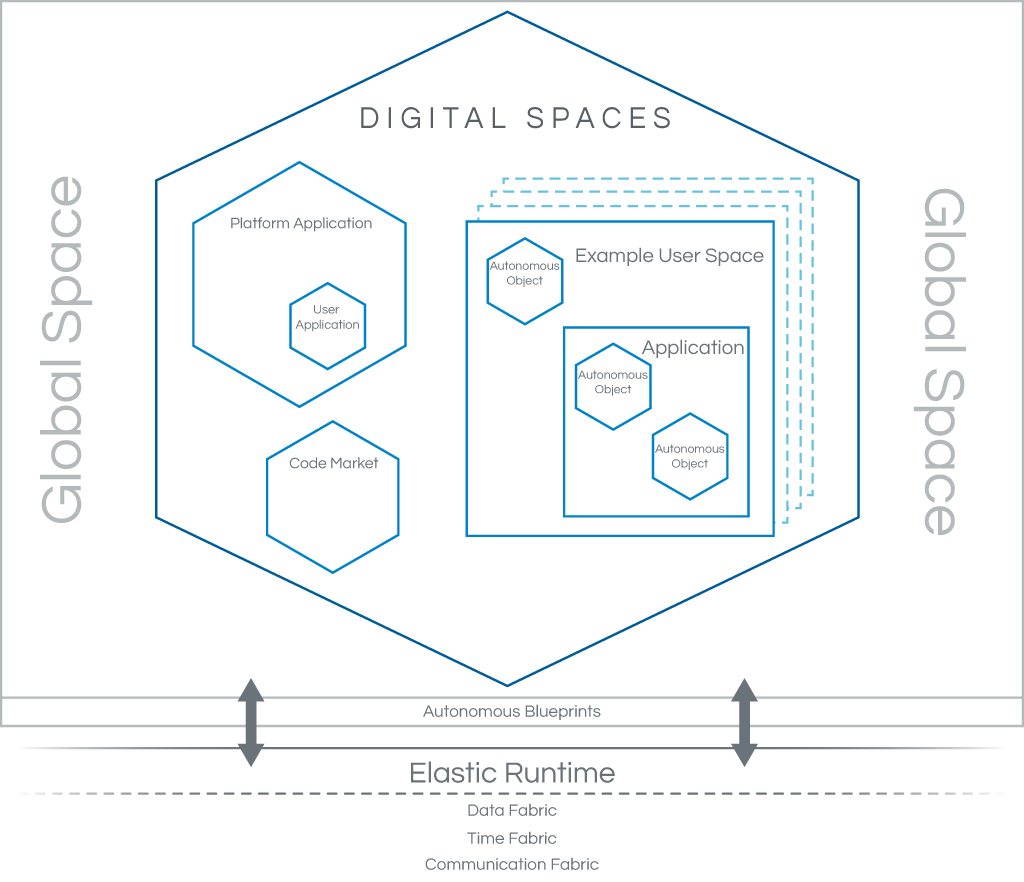
More than just a platform, the digital world we provide is entirely made up of Autonomous Objects. These entities were designed to feel like traditional objects (if your familiar with object-oriented programming), but have been evolved in a way that solves many of the modern challenges associated with building geographically distributed highly elastic software. Autonomous Objects bring together code and data to form a single logical unit that provides all of the functionality of what we today know as a “stack” (storage, messaging, eventing, etc). They can operate by themselves as mini-applications or work with other Autonomous Objects to make up a more sophisticated application. They are built to be interacted with directly (both internally and externally) and can represent anything from tangible real-world things like homes, cars, or people, to intangible things like lists, sensor readings, or calendar events.
Elastic Runtime
Simplify and address the challenges associated with writing software that is highly scalable and locality agnostic while dynamically running it when and where it makes the most sense — be it locally, regionally or globally.
To achieve the radical simplicity and intuitiveness that is object-oriented application architecture we needed to develop a new type of software execution layer that would support this entirely new way of building, running and sharing applications. A grouping of many technical innovations, the sole purpose of the Elastic Runtime is to bridge silos and present a seamless and simple layer of execution, persistence and communication to Autonomous Objects. It was built to extend beyond data centers — into the physical environments that people occupy — intelligently scheduling and executing the code that make up Autonomous Objects when and where it makes the most sense. This layer handles all the heavy lifting allowing Autonomous Objects to be written without concern for any of the complexities typically associated with application code.
Code Market
Accelerate innovation by giving people the ability to easily share their efforts in an extensible way without sharing their source code; while provide the opportunity to be compensated for the work when it is used.
Given the unique nature of Autonomous Objects we thought it only appropriate to unlock the full potential of the code sharing economy. The code market makes it easy for developers to write code, package it up as a Autonomous Blueprints, and optionally share these Blueprints with others for direct use or to further extend. But unlike traditional open source solutions, that doesn’t mean sharing your source code, it only means sharing your functionality. The platform uses your Blueprints without having to share the underlying code. As an added bonus innovators will also have the ability to set an up-front on-demand price for using their Autonomous Blueprints. For the first time, you will be able to build, share and be compensated without the hassle of building an end-to-end offering, worrying source code may be misused, or figuring out how to be rewarded for your time and effort.